
I’m no stranger to Japan, with six trips under my belt over the last decade. But after the birth of my daughter, I found myself feeling completely overwhelmed trying to work out all the logistics that come with travelling with a tiny human.
Should we go to Japan for our first international trip as a family? Would it be smarter to start somewhere closer to home? Were we completely crazy for booking a 12-hour flight for our daughter’s first ever plane journey?
These were just some of the questions running through our minds. But in the end, we decided to take the plunge and, fittingly, return to Japan for trip number seven – this time with our seven-month-old daughter, Sage, along for the adventure.
In this guide, I’ll share everything I wish I’d known before we went, from getting around with a pram and finding nappies and baby supplies, to locating changing facilities, choosing family-friendly accommodation, eating out, and planning an itinerary that works with a little one in tow.

How Baby Friendly is Japan?
As it turns out, Japan is a great country to travel with a baby.
Overall, we found Japan to be incredibly family-friendly. Changing and nursing rooms are everywhere, and even many public toilets are equipped with fold-down baby seats, making toilet stops much easier. Trains have dedicated accessible spaces for prams alongside priority seating.

One of the things that surprised us most was how much attention Sage received. My husband and I kept joking that we’d never interacted with so many strangers while travelling.
Particularly in smaller towns and rural areas on our Kyushu road trip, locals and other tourists would stop to wave, smile or play peekaboo with her, and she absolutely loved the extra attention.

Hotels in Japan were great for simplifying the day-to-day logistics of travelling with a baby. Every hotel we stayed in had self-service laundry facilities, while most also provided a communal microwave, making it easy to sterilise bottles.

That said, no destination is perfect. We found the biggest challenges were finding baby-friendly restaurants and choosing hotel rooms with enough space for all the extra stuff that comes with travelling as a family. I’ll share my tips for both below.
Before You Go
Best Time to Go
Let’s start with one of the biggest decisions you’ll make before booking your trip, because the time of year can have a huge impact on how enjoyable travelling with a baby is in Japan.

I would really reconsider travelling to Japan during the peak of summer in July and August. It’s incredibly hot and humid, making baby wearing uncomfortable and keeping your little one cool is a constant challenge – particularly for younger babies who can’t regulate their body temperature as well.
Summer in Japan also brings the highest chance of rain, which makes getting around with a pram or carrier even more difficult.
We travelled in May and experienced a mix of warm, sunny days and cooler weather. I actually found the cooler days much easier. We didn’t have to worry about Sage overheating, and contact naps in the carrier (which happened often!) were much more comfortable for both of us.

Flying To Japan
The flights were easily the part I was most nervous about before our trip.
Sage isn’t exactly what you’d call a chill baby. She’s been incredibly alert from almost day one, needs constant stimulation, and is a terrible sleeper. The thought of entertaining her for 12 hours at 35,000 feet felt more intimidating than the trip itself.

Because of her temperament, we strategically booked overnight flights in the hope she’d sleep through a good portion of the journey. Thankfully, it worked reasonably well. Every baby is different though, so I’d recommend choosing flight times that best suit your own little one’s sleep patterns and personality.
We flew with Singapore Airlines via Singapore, breaking the journey into a five-hour flight followed by a seven-hour flight to Tokyo. Looking back, I’d probably pay extra for a direct flight next time. Wandering around Changi Airport at midnight with an overtired baby who was far too stimulated to sleep wasn’t exactly a highlight of the trip!
Tip: Aeroplane toilets are tiny, and changing a wriggly baby in them can be a challenge. Rather than squeezing our entire nappy bag into the cubicle every time, I bought this small nappy clutch with a fold-out change mat containing just the essentials.
It made every nappy change so much easier and has ended up being one of the most-used baby purchases we’ve made – we still use it every day at home.

Booking bassinet seats was also well worth it.
At seven months old, Sage was still small enough to sleep in the bassinet for a few hours overnight, and when she was awake it became a handy spot to keep toys, bottles and other bits and pieces off our laps. As an added bonus, bassinet seats also come with extra legroom at no additional cost (at least when flying with Singapore Airlines).
Tip: I packed far too many toys for the flight. Most of them held Sage’s attention for about five minutes before ending up back in the nappy bag or on the floor. In reality, she was far more interested in everyday objects like paper cups, napkins, plastic cutlery and the safety card!
If I were only bringing one toy again, it would be a suction-cup fidget spinners, which sticks to the plane window or tray table and is great bang-for-buck when it comes to entertainment vs space.
Getting Around Japan
Pram & Carrier
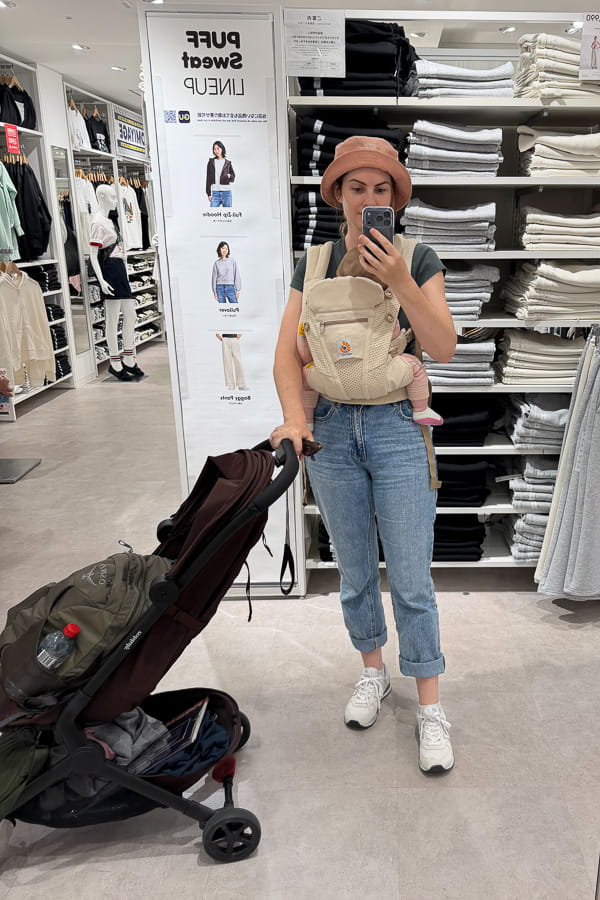
We took both our carrier and travel pram, and I’d highly recommend packing both if you can.
The travel pram was invaluable. We used it right up until boarding our flights before taking it as carry-on luggage, and once we arrived in Japan, it was used on a daily basis. Not only did it transport Sage, but it also carried our nappy bag, jackets, shopping and anything else we accumulated throughout the day.

Our baby carrier was equally valuable. I used it to help Sage fall asleep on the plane when the bright lights were on, for contact naps while sightseeing, on hikes, and anytime she needed a break from the pram.
Having both options gave us so much more flexibility throughout the trip.
Train
Japan’s trains are incredibly easy to navigate with a baby. Most trains have designated accessible areas with space for prams, along with priority seating nearby.
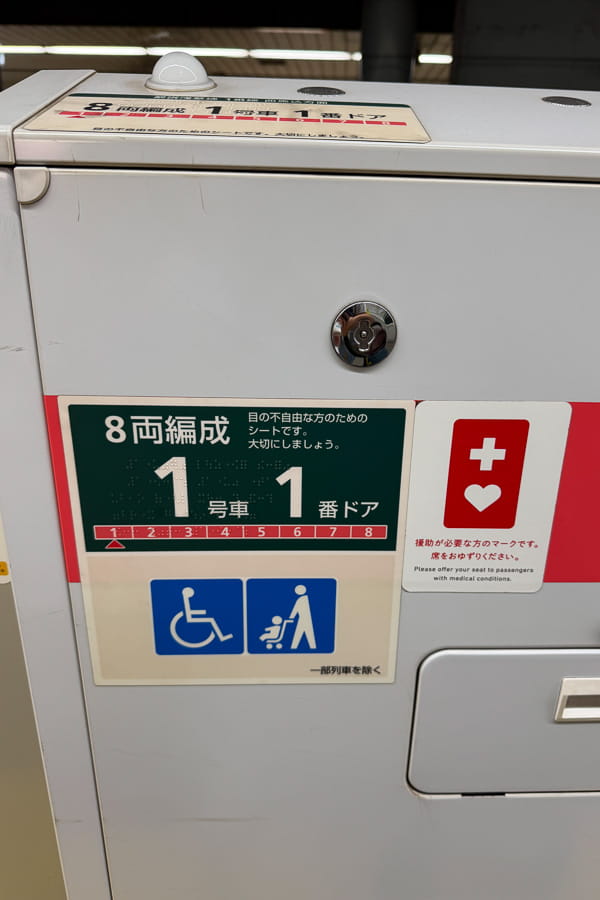
The only time we struggled was during Tokyo’s peak-hour rush. We accidentally boarded the busy Yamanote Line around 5 pm with the pram, and it was absolutely packed – think shoulder-to-shoulder, sardine-can packed.
I regretted getting on it as more and more people crammed in and the pram was jammed up against my legs while sitting in the priority seat with Sage on my lap. Not a fun moment.
It’s an experience I’d happily avoid next time, so if your itinerary allows, try to travel outside the morning and evening commuter rush.
Tip: Turn on Wheelchair Accessible directions in Google Maps. Finding lifts within Japan’s sprawling train stations can be surprisingly difficult, and this setting directs you to accessible entrances and exits, saving you from unnecessary stairs.
Even with it, there were more than a few occasions where my husband ended up carrying the pram up multiple flights of stairs!
Luggage Delivery
The biggest challenge of travelling around Japan wasn’t the trains – it was the amount of luggage that came with travelling as a family.
On our previous trip to Japan, my husband and I shared one medium-sized suitcase. This time we had a large suitcase, backpacks, a nappy bag, a travel cot and a travel pram. It’s amazing how much extra gear a tiny human requires?!
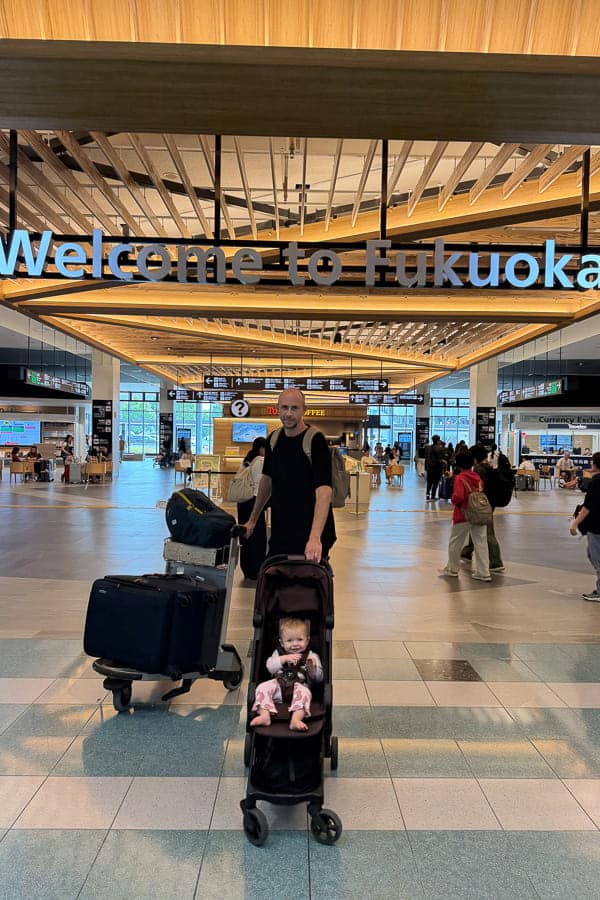
That’s why I’d highly recommend taking advantage of Japan’s efficient luggage delivery service when travelling between cities, particularly if you’re catching the Shinkansen. It’s affordable, incredibly reliable and means you can travel with just a small overnight bag while your larger luggage is delivered to your next hotel the following day.
Read more about luggage delivery in my First Timers to Japan guide here.
Tip: Babies and children under six travel free on the Shinkansen provided they don’t occupy their own reserved seat. If they’re happy to sit on your lap, you won’t need to purchase a ticket for them.
Taxi
Child car seats are not legally required in taxis in Japan. When we occasionally caught a taxi, we either held Sage on our lap or had her in the baby carrier.
That said, taxis were only a small part of our trip. We relied on public transport for around 95% of our sightseeing and generally only used taxis for short journeys of 15 minutes or less.
We caught the train to and from Haneda Airport, which was easy enough with a baby and luggage in off-peak travel times.
However, if you’d prefer a more seamless arrival, you can also book private airport transfers with child seats.
Rental Car
While you definitely don’t need a car in cities like Tokyo, Osaka or Kyoto, a rental car can be invaluable when exploring Japan’s more rural regions.
We spent most of our trip exploring Kyushu, where having a car gave us the freedom to visit remote hot springs, scenic gorges and smaller towns that would have been difficult to reach using public transport alone.

When booking our hire car, we requested a rear-facing infant seat. It was noticeably more upright than our car seat back home in Australia, and I may have been less suitable for a younger baby with limited head and neck control.

Tip: If you’re travelling with a younger infant, I’d recommend contacting the rental company ahead of time and asking for photos or specifications of the child seat they’ll be providing. It will give you peace of mind that it’s appropriate for your baby’s age and stage of development.
Across seven trips to Japan, we’ve only hired a car twice: once while exploring the Fuji Five Lakes region and again in rural Kyushu.
For most first-time visitors sticking to Japan’s major cities and tourist routes, the country’s excellent rail network is more than sufficient and will save the stress of navigating busy cities in a rental car.
Baby Essentials in Japan
Buying Nappies
If you’re wondering whether you can easily buy nappies in Japan, the answer is yes – but you need to know where to look.
Because nappies take up a lot of shelf space, most convenience stores don’t stock them. Across our entire trip, we only came across one 7-Eleven in Tokyo selling nappies, and it only had a small three-pack in one size only.

Instead, head to a drugstore or dedicated baby store. Large pharmacy chains such as Matsumoto Kiyoshi, Welcia and Sun Drug all stock nappies, as do dedicated baby stores like Akachan Honpo and Babies “R” Us. You’ll also find them in supermarkets, although these can be surprisingly difficult to come across in the more touristy parts of major cities.
Tip: The Japanese word for nappy (or diaper) is オムツ (omutsu). If you’re struggling to find them, simply show this word to a staff member or ask, “Omutsu wa doko desu ka?” (“Where are the nappies?”).
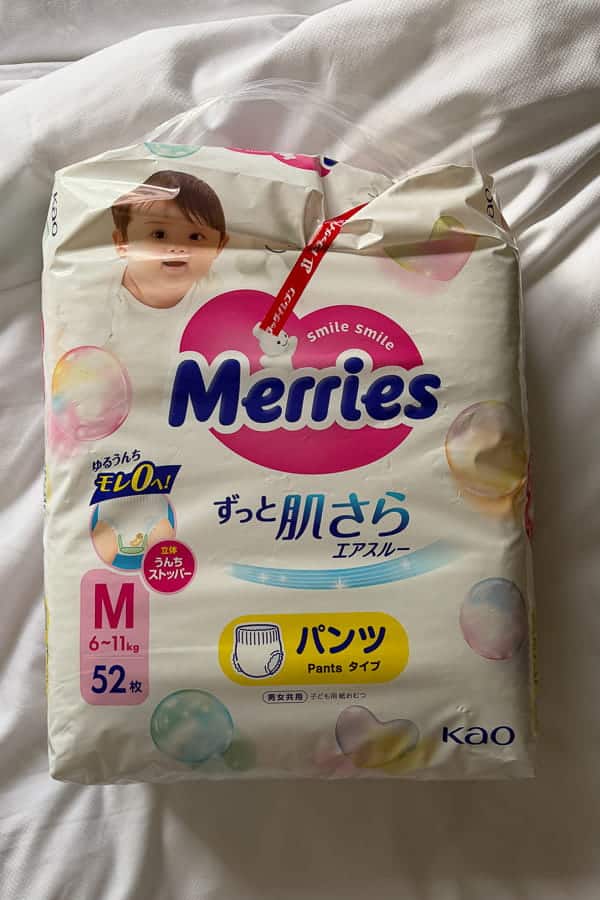
At home, Sage wore tape-style nappies, but the drugstore we visited only stocked pull-up nappy pants in her size. We were a little hesitant at first, but they ended up being a game-changer for our very wriggly baby.
In fact, we liked them so much that we switched to pull-ups permanently once we returned home.
The most common brands we came across were Merries, Pampers and Moony. We used Merries throughout our trip and found them excellent – soft, absorbent and with no leaks or irritation. They were also cheaper than what we typically pay in Australia, costing around ¥1,400 for a large pack of 52 nappies.
Changing Facilities
This was so much easier than at home in Australia and one way in which Japan is far superior.
Changing rooms were everywhere and were consistently spotlessly clean. Many department stores also had dedicated parent rooms equipped with hot sterilised water, microwaves, bottle preparation areas and private breastfeeding rooms, making it incredibly easy to manage changing and feeding while out.
Tip: Download the MamaPapa app before your trip. It shows nearby baby changing and feeding facilities, making it easy to find somewhere suitable when you’re out exploring.

Breastfeeding in Japan
I found Japan to be exceptionally breastfeeding-friendly.
Private, comfortable feeding rooms were common – even inside stores like Uniqlo. Department stores became my go-to whenever Sage needed feeding, as they almost always had dedicated parent rooms with comfortable seating and excellent facilities.

Check the floor guide (near the entrance and elevators) for the baby bottle symbol to find the feeding and nursery rooms.

Bottle Feeding & Formula
As Sage is combination-fed, we also needed to travel with bottles, formula and sterilising equipment. It felt a little daunting before we left, but we quickly settled into a simple routine.
I purchased this travel-sized bottle washing set, Milton sterilising tablets and sterilising microwave bags.
Each evening we’d wash the bottles in the hotel bathroom sink using hot, soapy water before sterilising them. If the hotel had a microwave (which was common), we’d use the microwave bags. Otherwise, we’d use the cold-water sterilisation technique with the Milton tablets.
Every hotel room we stayed in also had a kettle, making it easy to boil fresh water for bottles each day. Many parent rooms also provided sterile hot water, which was incredibly handy when preparing bottles while we were out and about.
Because Sage requires a specialised formula due to her cow’s milk protein intolerance (CMPI), we packed enough formula from Australia for the entire trip.
Formula is available in Japan, although the brands were unfamiliar to us. If your baby already has a formula they’re happy on, I’d recommend bringing enough from home to avoid any unexpected tummy troubles.
As an added bonus, you’ll free up plenty of luggage space as you finish each tin – leaving more room for all your shopping on the way home!
Baby Food
At seven months old, Sage had only started solids about a month before our trip, so there wasn’t any pressure for her to eat full meals – we aimed to offer her food once or twice a day if the opportunity presented itself; otherwise we weren’t too stressed about it for the duration of the trip.
When we ran out of the teething rusks we’d packed from home, we had no trouble finding more at local drugstores and supermarkets.
We also came across plenty of purée pouches and other baby snacks, so we never felt like we were short on options. We used Google Translate to check the ingredients list for any nasties or untested allergens.

As we mostly follow baby-led weaning, we often shared our own meals with Sage where it was safe to do so. One of her favourites was cucumber sushi rolls and tamagoyaki (Japanese omelette), which quickly became our go-to options whenever we were eating out.
If your baby is already established on solids, I’d still recommend packing a few familiar snacks from home for flights and longer travel days. But overall, we found feeding a baby in Japan much easier than we’d expected.
Eating Out in Japan
Of all the practical aspects of travelling with a baby, we found eating out to be one of the biggest adjustments compared to travelling around Australia.
Many of the restaurants we would have happily wandered into on previous trips simply weren’t designed with babies in mind.
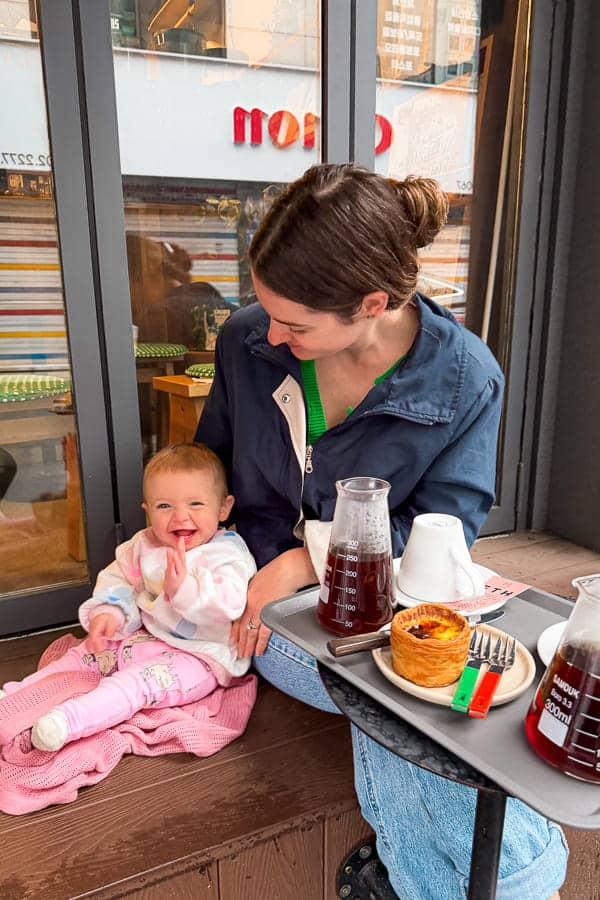
Small ramen shops, for example, often only have a handful of seats at a counter, leaving no room for a pram. They’re also very much “eat and leave” establishments rather than somewhere to linger over a meal. Likewise, some izakayas don’t welcome young children, while many still allow indoor smoking.
Rather than trying to make those restaurants work, we quickly learned to seek out places that were better suited to families.
My biggest recommendation is to download the Tabelog app and use the children welcome filter when searching for restaurants.

We also checked Google Maps photos before heading somewhere to see whether there were tables with enough space for our travel pram if highchairs weren’t available.
Conveyor belt sushi restaurants quickly became our favourite family meal. Chains like Kura Sushi and Sushiro ticked every box: spacious booths, highchairs, tablet ordering, quick service, and plenty of simple options that Sage could enjoy.
When we were craving yakitori, the chain restaurant Torikizoku became another reliable option. While they didn’t have highchairs, we could usually get a booth, keep Sage on our laps, and order everything from the tablet with an English option.

The food also arrived quickly, which is always a bonus when dining with a baby.
For ramen, if you want to dine together, I recommend sticking to the larger chains like Ippudo and Ichiran, which tend to be more accommodating for families.
If there was a smaller ramen shop we really wanted to try, we’d simply take turns – one of us would eat while the other took Sage for a walk, then we’d swap.
And when all else fails, good ol’ Uber Eats deliveries to the hotel for those days when we didn’t feel up to venturing out for dinner after a long day of exploring.
Accommodation Tips
If there’s one thing to prioritise when booking accommodation in Japan, it’s room size.
Japanese hotel rooms are often much smaller than many travellers are used to, so always check the room size before booking – even if you’re not travelling with a baby. On this trip, I aimed to book rooms that were at least 21 m², which gave us enough space for our luggage, travel cot and the inevitable explosion of baby gear.
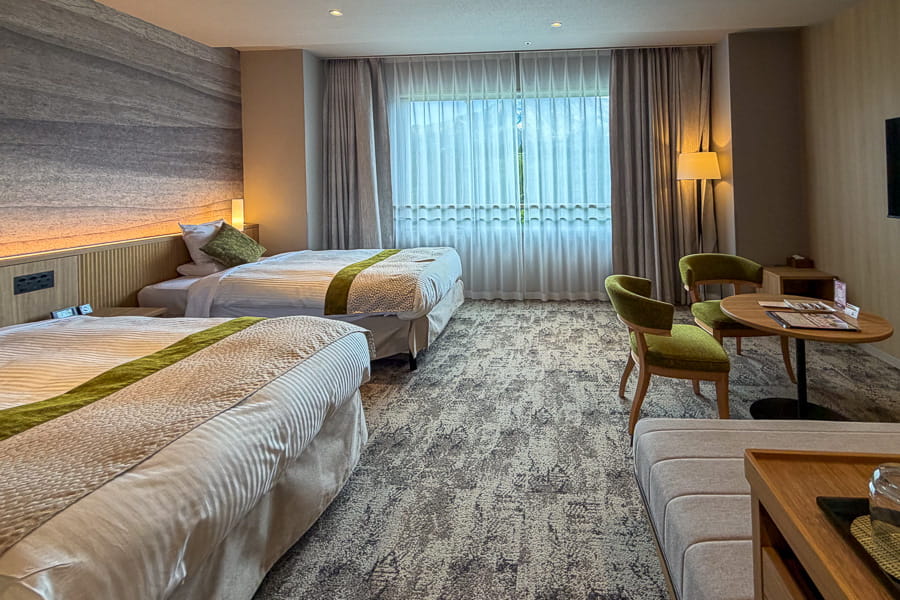
Finding larger rooms was much easier in rural Kyushu than in Tokyo, where space comes at a premium. If you’re planning to stay in Japan’s major cities, it’s worth factoring the cost of larger rooms into your travel budget.
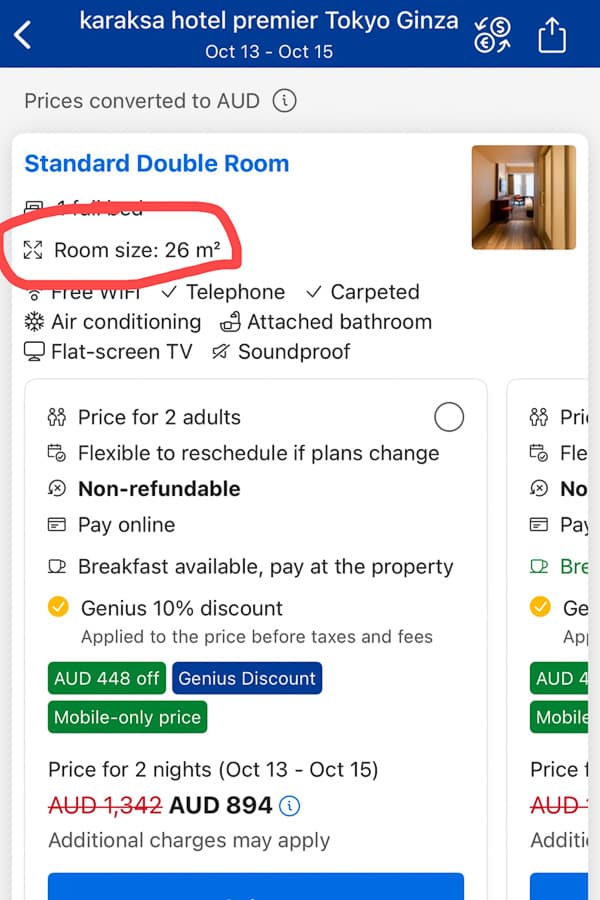
Read my guide on How Much it Costs to Travel Japan here.
We brought our BabyBjörn Travel Cot, so Sage had a familiar and safe place to sleep each night. Many hotels also offered cots, although they’re not as universally available as they are in Australia, as most Japanese families bed share, so it’s important to check before booking if you’ll be relying on one,
Tip: We found many hotels referred to cots as “baby beds” rather than cots. Likewise, prams are called “baby cars” – so cute!
If you’re travelling with two adults and one baby, you shouldn’t have too much trouble finding suitable accommodation, provided the room is large enough for a travel cot (or the hotel supplies one).
Larger families can find it a little trickier, so apartment-style accommodation is often worth considering.
Some of our favourite family-friendly hotel chains include:
- Mimaru – Spacious apartment-style accommodation designed with families in mind. Their rooms include kitchenettes, dining areas and plenty of space, with properties across Tokyo, Kyoto and Osaka.
- &Here – A newer apartment hotel brand offering generous rooms that are well suited to families, currently with locations in Tokyo and Osaka.
- Tokyu Stay – A fantastic option for longer stays, with many rooms featuring a kitchenette, microwave and even an in-room washing machine.
Tip: Try to recreate your baby’s bedtime routine as closely as possible. For us, that meant a bath, a book and our portable white noise machine every evening. Keeping those familiar cues made settling Sage in an unfamiliar environment much easier.
One purchase that I wasn’t sure about but ended up being absolutely worth it was a SnoozeShade cover for our travel cot.
It helped create a dark sleep environment even when hotel curtains weren’t fully blackout, and meant my husband and I could watch a movie in bed after she’d gone to sleep without worrying about the light waking her.
Suggested Japan Itineraries with a Baby
The great thing about travelling to Japan with a younger baby (as opposed to a busy toddler!) is that your itinerary doesn’t need much adapting from what you would have done pre-baby.
I just made sure that we travelled at a slightly slower pace, allowing time for us to all have some downtime or the occasional nap back at the hotel, but we still largely did all the things we would have done anyway pre-baby and managed most naps on the go using the carrier.
If it’s your first visit to Japan, I’d recommend sticking with the classic Golden Route itinerary of Tokyo, Kyoto and Osaka. It’s popular for good reason and offers a fantastic introduction to the country.

If you’d prefer to unpack less, another great option is to base yourself in Tokyo for a week and take advantage of easy day trips, or spend a couple of nights in Hakone or the Fuji Five Lakes region.

If you’ve already experienced the Golden Route, our Kyushu road trip was an amazing destination to explore with a baby. The slower pace, beautiful nature, quiet towns and scenic drives made it feel particularly well suited to family travel.
Tip: Be strategic about when you visit Japan’s most popular attractions. Places like Kyoto’s famous temples and shrines are far more enjoyable early in the morning or later in the afternoon, when crowds are lighter, and it’s easier to navigate with a pram or baby carrier (steal my 3 day Kyoto itinerary here, designed to avoid the crowds).
We also found ourselves using taxis a little more often to avoid squeezing onto packed trains during peak hour.
What To Pack
Here’s my baby packing list, tried and tested. Where applicable, I’ve linked the products I use and love.
Medical:
- Baby Paracetamol
- Thermometer
- Nail Trimmer
- Snotsucker and Nasal Saline Spray
Changing:
- Nappies – enough to get you through a few days until you buy some
- Wipes
- Travel Size Nappy Cream
- Nappy Disposal Bags
- Nappy Clutch
Other:
- Clothes (including at least one spare outfit for the plane)
- Sun Hat
- Swim nappy and bathers
- A few select toys
- Muslin Cloth
Transport:
- Baby Carrier (I have the Ergobaby Omni)
- Travel Pram & Pram Bag (you’ll need a bag if you want to take it as carry-on on the plane)
- Pram Fan
- Pram Clips
- Muslin Cloth & Blanket
Sleep:
- Travel Cot (if you plan on using one)
- SnoozeShade
- White Noise
- Sleep Sack
Feeding:
- Bottles
- Travel bottle washing set
- Microwave sterilising bags
- Milton sterilising tablets
- Stackable Formula Dispenser
- Formula Tin/s
- Bib
- Sippy Cup
Tip: I grabbed these clear cubes from Kmart, and they came in super handy – I used one to store our baby medicinal supplies, and toys in the other for organisation and easy grab and go in the nappy bag.
Final Thoughts
I’m so glad we took the plunge and travelled with Sage when we did. Even better, that we got to share Japan with her, our favourite country in the world.
Was it different to travelling pre-baby? Of course. We moved at a slower pace, planned our days a little more carefully, and often called it a night after dinner to head back to the hotel.
But we still wandered through temples, soaked up beautiful scenery, discovered incredible food, and made memories that we’ll treasure forever.
If anything, travelling with Sage gave us the chance to experience Japan in a completely new way. We found ourselves chatting with locals more often and appreciating the little moments just as much as the big attractions.
Watching her experience a new country for the first time is such a special experience.
If you’re feeling nervous about taking your baby to Japan, I hope this guide has given you the confidence to go for it. No trip with a baby is ever going to be completely seamless, but Japan makes it surprisingly easy. With a little extra planning and realistic expectations, I genuinely think it’s one of the best destinations in the world for a first international family adventure.
I have a feeling it might be the first of many family trips to Japan for us.
Check out my other guides to help with your Japan travel planning: